
Concept profile
ConnectionUsage
Represents a structural connection with end features. It combines PartUsage and ConnectorAsUsage semantics and retains its own model-element identity.
Status: draft, source-checked. Editorial explanation with separately identified source declarations and original illustrative redraws.
Original XMI declaration. §7.13.2 Connection Definitions and Usages, printed 68 / PDF 100; §8.3.13.4 ConnectionUsage, printed 298 / PDF 330
Source evidence 3 locations
- SysML 2.0Original XMI declarationptc/25-02-15
- SysML 2.0 Language§7.13.2 Connection Definitions and Usages, printed 68 / PDF 100formal/2026-03-02
- SysML 2.0 Language§8.3.13.4 ConnectionUsage, printed 298 / PDF 330formal/2026-03-02
What to understand
- A connection is a model element with end roles and references, even when drawn as a simple line.
- Nonabstract connections require at least two ends. Each end is referential with multiplicity 1..1; cross multiplicity is a separate concept.
- Allowed typing includes connection definitions and suitable KerML association structures.
- A structural connection is not interchangeable with a binding, succession or flow.
Graphical notation
These are representative, source-checked variants, not an exhaustive notation grammar. The illustrations are original redraws, not official figures.
Binary edge and connection node
Context: Structural connection representations.
A connection can use a solid binary line with an optional label, or a rounded full node labeled connection. The example omits the optional direction-indication arrow.
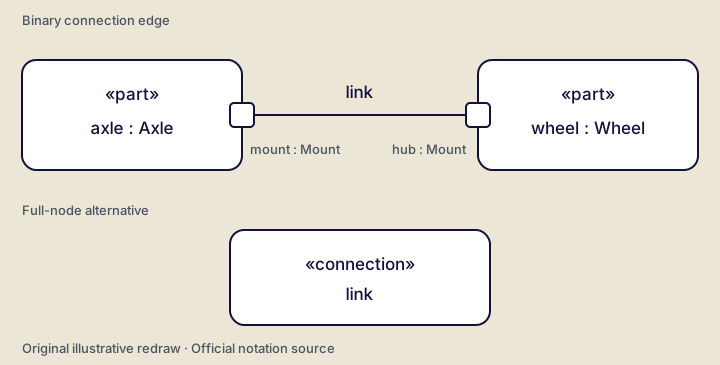
§8.2.3.13 Connections, printed 215 / PDF 247; §8.2.3.13 Connections, printed 216 / PDF 248
N-ary connection variant
Context: Connections with more than two ends.
The grammar also provides a central filled dot with segments to the connected usage nodes. It is an additional representation, not a universal replacement for binary lines.
§8.2.3.13 Connections, printed 216 / PDF 248
Source evidence 2 locations
- SysML 2.0 Language§8.2.3.13 Connections, printed 215 / PDF 247formal/2026-03-02
- SysML 2.0 Language§8.2.3.13 Connections, printed 216 / PDF 248formal/2026-03-02
Relationships and composition
Specialization: PartUsage
ConnectionUsage directly specializes PartUsage as well as ConnectorAsUsage.
Condition: A connection therefore has inherited part properties, but adds connector end structure and applicable constraints.
§8.3.13.4, printed 298 / PDF 330
Endpoint reference: PortUsage
The example connects two port usages through qualified feature paths.
Condition: Retain the connection end declarations and their reference-subsetting semantics, rather than storing only a graphical line.
Source evidence 2 locations
- SysML 2.0 Language§8.3.13.4, printed 298 / PDF 330formal/2026-03-02
- SysML 2.0 Language§7.13.2, printed 71 / PDF 103formal/2026-03-02
Connected example
link is a named binary connection. Its ends refer to axle.mount and wheel.hub. The plain solid line is an illustrative connection representation, with no flow direction implied.
// Original documentation example. Source-reviewed; not parser-validated.
package AssemblyExample {
    port def Mount;

    part def Wheel {
        port hub : Mount;
    }

    part def Axle {
        port mount : Mount;
    }

    part def Assembly {
        part wheel : Wheel;
        part axle : Axle;
        ref part spare : Wheel[0..1];
        connection link connect axle.mount to wheel.hub;
    }

    part assembly : Assembly;
}
Verification: source-reviewed, not parser-validated or executed. §7.13.2 binary connection shorthand, printed 71 / PDF 103
Source evidence 1 location
- SysML 2.0 Language§7.13.2 binary connection shorthand, printed 71 / PDF 103formal/2026-03-02
Properties
The explicit-redefinition view contains 121 active declarations, retaining declaration origins and excluding 8 replaced declarations. It deduplicates diamond paths by identity, excludes private inherited fields, and reports unresolved same-name collisions instead of choosing a winner.
These are metamodel property cardinalities and declared defaults. They do not determine the multiplicity or runtime values of a part, port or connection in a user model. Derived values still require their derivation rules. See property rules.
View 121 property declarations
| Property | Meaning | Type | Bounds | Declared on | Declared default |
|---|---|---|---|---|---|
| aliasIds | Alternative identifiers for this element, typically supplied by tools. | String | 0..* | Element | No declared default |
| chainingFeature | The ordered features whose successive navigation determines this feature’s modeled values. | Feature | 0..* | Feature | No declared default |
| connectionDefinition | The association structures typing this connection usage, including compatible KerML library association structures. | AssociationStructure | 0..* | ConnectionUsage | No declared default |
| connectorEnd | The connector’s end features, which redefine association ends and reference the connected features. | Feature | 0..* | Connector | No declared default |
| crossFeature | The navigational feature constraining collections reached across the other ends of the same owning type. | Feature | 0..1 | Feature | No declared default |
| declaredName | The primary name explicitly supplied for this element. | String | 0..1 | Element | No declared default |
| declaredShortName | An explicitly supplied compact alternative name whose contextual uniqueness is the modeler’s responsibility. | String | 0..1 | Element | No declared default |
| defaultFeaturingType | The innermost shared featuring context of the related features that would satisfy the connector’s type-featuring check, if one exists. | Type | 0..1 | Connector | No declared default |
| differencingType | The ordered types defining this type as the first type’s interpretations minus those of subsequent types. | Type | 0..* | Type | No declared default |
| directedFeature | The features of this type with an explicit direction. | Feature | 0..* | Type | No declared default |
| directedUsage | The usage features in this context that have an explicit direction. | Usage | 0..* | Usage | No declared default |
| direction | Describes whether modeled feature values serve as inputs, outputs, or both. | FeatureDirectionKind | 0..1 | Feature | No declared default |
| documentation | The documentation elements owned by this element. | Documentation | 0..* | Element | No declared default |
| elementId | The tooling-assigned global identifier intended to remain stable for this element’s lifetime. | String | 1..1 | Element | No declared default |
| endOwningType | The type owning this feature through an end-feature membership. | Type | 0..1 | Feature | No declared default |
| feature | The features available through this type’s feature memberships, including inherited features. | Feature | 0..* | Type | No declared default |
| featureMembership | The owned and inherited feature memberships of this type, excluding imported memberships. | FeatureMembership | 0..* | Type | No declared default |
| featureTarget | The final feature in this feature’s navigation chain, or this feature when no chain exists. | Feature | 1..1 | Feature | No declared default |
| featuringType | The types that every domain instance from which this feature is evaluated must satisfy. | Type | 0..* | Feature | No declared default |
| importedMembership | The memberships made available by imports owned by this namespace. | Membership | 0..* | Namespace | No declared default |
| individualDefinition | The optional occurrence definition typing this usage that is marked individual. | OccurrenceDefinition | 0..1 | OccurrenceUsage | No declared default |
| inheritedFeature | The features obtained through inherited feature memberships. | Feature | 0..* | Type | No declared default |
| inheritedMembership | The memberships made available to this type by specialization or conjugation. | Membership | 0..* | Type | No declared default |
| input | The features of this type directed into the type, including bidirectional features. | Feature | 0..* | Type | No declared default |
| intersectingType | The types whose shared interpretations define this type. | Type | 0..* | Type | No declared default |
| isAbstract | Requires every instance of this type to also instantiate a more specialized type. | Boolean | 1..1 | Type | false (LiteralBoolean) |
| isComposite | Makes modeled values dependent on their featuring instance for continued existence and exclusive to that instance across composite features. | Boolean | 1..1 | Feature | false (LiteralBoolean) |
| isConjugated | Records whether this type owns a conjugation as its conjugator. | Boolean | 1..1 | Type | No declared default |
| isConstant | Keeps the modeled value unchanged across snapshots even when the feature is variable. | Boolean | 1..1 | Feature | false (LiteralBoolean) |
| isDerived | Indicates that modeled values of this feature are always computable from other feature values. | Boolean | 1..1 | Feature | false (LiteralBoolean) |
| isEnd | Marks a feature as an end, mapping each domain instance to one value; navigation cardinality can additionally be constrained through its cross feature. | Boolean | 1..1 | Feature | false (LiteralBoolean) |
| isImplied | Identifies a relationship introduced by tooling to satisfy language semantics rather than directly authored by a modeler. | Boolean | 1..1 | Relationship | false (LiteralBoolean) |
| isImpliedIncluded | Records that all required implied owned relationships are included; false requires that none be included. | Boolean | 1..1 | Element | false (LiteralBoolean) |
| isIndividual | Identifies a usage of the specific individual designated by its individual definition. | Boolean | 1..1 | OccurrenceUsage | false (LiteralBoolean) |
| isLibraryElement | Indicates that this element lies within the ownership tree of a library model. | Boolean | 1..1 | Element | No declared default |
| isOrdered | Records whether the modeled feature values have a meaningful sequence. | Boolean | 1..1 | Feature | false (LiteralBoolean) |
| isPortion | Indicates that modeled values are spatial or temporal portions of their domain instance and represent that same thing. | Boolean | 1..1 | Feature | false (LiteralBoolean) |
| isReference | The derived opposite of isComposite, identifying usage values without composite lifetime dependence. | Boolean | 1..1 | Usage | No declared default |
| isSufficient | Makes satisfying this type’s classification conditions sufficient for classification by the type. | Boolean | 1..1 | Type | false (LiteralBoolean) |
| isUnique | Requires the modeled collection of feature values to contain no repeated values when true. | Boolean | 1..1 | Feature | true (LiteralBoolean) |
| isVariation | Marks a variation point and requires its relevant memberships to be variant memberships. | Boolean | 1..1 | Usage | No declared default |
| itemDefinition | The structures typing this item usage, including compatible KerML library structures. | Structure | 0..* | ItemUsage | No declared default |
| mayTimeVary | The derived replacement for Feature.isVariable indicating snapshot-based featuring; isConstant can still require the same value throughout an occurrence. | Boolean | 1..1 | Usage | No declared default |
| member | The elements available as members through this namespace’s memberships. | Element | 0..* | Namespace | No declared default |
| membership | The memberships available in this namespace, including owned and imported memberships. | Membership | 0..* | Namespace | No declared default |
| multiplicity | The owned multiplicity constraining this type’s modeled cardinality; without one, applicable supertype multiplicities still constrain it. | Multiplicity | 0..1 | Type | No declared default |
| name | The effective name used for namespace lookup, which some element kinds compute rather than declare. | String | 0..1 | Element | No declared default |
| nestedAction | The action usages owned as features by this usage. | ActionUsage | 0..* | Usage | No declared default |
| nestedAllocation | The allocation usages owned as features by this usage. | AllocationUsage | 0..* | Usage | No declared default |
| nestedAnalysisCase | The analysis case usages owned as features by this usage. | AnalysisCaseUsage | 0..* | Usage | No declared default |
| nestedAttribute | The attribute usages owned as features by this usage. | AttributeUsage | 0..* | Usage | No declared default |
| nestedCalculation | The calculation usages owned as features by this usage. | CalculationUsage | 0..* | Usage | No declared default |
| nestedCase | The case usages owned as features by this usage. | CaseUsage | 0..* | Usage | No declared default |
| nestedConcern | The concern usages owned as features by this usage. | ConcernUsage | 0..* | Usage | No declared default |
| nestedConnection | The connector-as-usages, including binding, succession and flow usages owned as features by this usage. | ConnectorAsUsage | 0..* | Usage | No declared default |
| nestedConstraint | The constraint usages owned as features by this usage. | ConstraintUsage | 0..* | Usage | No declared default |
| nestedEnumeration | The enumeration usages owned as features by this usage. | EnumerationUsage | 0..* | Usage | No declared default |
| nestedFlow | The flow usages owned as features by this usage. | FlowUsage | 0..* | Usage | No declared default |
| nestedInterface | The interface usages owned as features by this usage. | InterfaceUsage | 0..* | Usage | No declared default |
| nestedItem | The item usages owned as features by this usage. | ItemUsage | 0..* | Usage | No declared default |
| nestedMetadata | The metadata usages owned as features by this usage. | MetadataUsage | 0..* | Usage | No declared default |
| nestedOccurrence | The occurrence usages owned as features by this usage. | OccurrenceUsage | 0..* | Usage | No declared default |
| nestedPart | The part usages owned as features by this usage. | PartUsage | 0..* | Usage | No declared default |
| nestedPort | The port usages owned as features by this usage. | PortUsage | 0..* | Usage | No declared default |
| nestedReference | The reference usages owned as features by this usage. | ReferenceUsage | 0..* | Usage | No declared default |
| nestedRendering | The rendering usages owned as features by this usage. | RenderingUsage | 0..* | Usage | No declared default |
| nestedRequirement | The requirement usages owned as features by this usage. | RequirementUsage | 0..* | Usage | No declared default |
| nestedState | The state usages owned as features by this usage. | StateUsage | 0..* | Usage | No declared default |
| nestedTransition | The transition usages owned as features by this usage. | TransitionUsage | 0..* | Usage | No declared default |
| nestedUsage | The usage features owned by this usage. | Usage | 0..* | Usage | No declared default |
| nestedUseCase | The use case usages owned as features by this usage. | UseCaseUsage | 0..* | Usage | No declared default |
| nestedVerificationCase | The verification case usages owned as features by this usage. | VerificationCaseUsage | 0..* | Usage | No declared default |
| nestedView | The view usages owned as features by this usage. | ViewUsage | 0..* | Usage | No declared default |
| nestedViewpoint | The viewpoint usages owned as features by this usage. | ViewpointUsage | 0..* | Usage | No declared default |
| occurrenceDefinition | The classes typing this occurrence usage, including compatible KerML library classes. | Class | 0..* | OccurrenceUsage | No declared default |
| output | The features of this type directed out of the type, including bidirectional features. | Feature | 0..* | Type | No declared default |
| ownedAnnotation | The annotation relationships owned here that annotate this element. | Annotation | 0..* | Element | No declared default |
| ownedConjugator | The optional conjugation owned here that treats this type as the original type. | Conjugation | 0..1 | Type | No declared default |
| ownedCrossSubsetting | The optional owned cross-subsetting relationship specifying this feature’s cross-navigation constraint. | CrossSubsetting | 0..1 | Feature | No declared default |
| ownedDifferencing | The owned difference relationships defining this type as their difference result. | Differencing | 0..* | Type | No declared default |
| ownedDisjoining | The owned disjointness relationships constraining this type against other types. | Disjoining | 0..* | Type | No declared default |
| ownedElement | The elements reached as owned related elements through this element’s owned relationships. | Element | 0..* | Element | No declared default |
| ownedEndFeature | The end features introduced through memberships owned by this type. | Feature | 0..* | Type | No declared default |
| ownedFeature | The features introduced through feature memberships owned by this type. | Feature | 0..* | Type | No declared default |
| ownedFeatureChaining | The owned relationships specifying the ordered steps used to navigate this feature. | FeatureChaining | 0..* | Feature | No declared default |
| ownedFeatureInverting | The owned relationships that give this feature an inverse navigation interpretation. | FeatureInverting | 0..* | Feature | No declared default |
| ownedFeatureMembership | The memberships owned here that introduce owned features of this type. | FeatureMembership | 0..* | Type | No declared default |
| ownedImport | The import relationships owned by this namespace. | Import | 0..* | Namespace | No declared default |
| ownedIntersecting | The owned intersection relationships defining this type as their intersection result. | Intersecting | 0..* | Type | No declared default |
| ownedMember | The member elements owned through this namespace’s owned memberships. | Element | 0..* | Namespace | No declared default |
| ownedMembership | The memberships owned by this namespace. | Membership | 0..* | Namespace | No declared default |
| ownedRedefinition | The owned subsetting relationships that replace inherited features with this redefining feature. | Redefinition | 0..* | Feature | No declared default |
| ownedReferenceSubsetting | The optional owned reference-subsetting relationship identifying the feature referenced by this feature. | ReferenceSubsetting | 0..1 | Feature | No declared default |
| ownedRelatedElement | The participating elements directly owned by this relationship. | Element | 0..* | Relationship | No declared default |
| ownedRelationship | The relationships owned by this element as their owning related element. | Relationship | 0..* | Element | No declared default |
| ownedSpecialization | The owned specialization relationships in which this type is the more specific type. | Specialization | 0..* | Type | No declared default |
| ownedSubsetting | The owned specializations that constrain this feature to select values from another feature. | Subsetting | 0..* | Feature | No declared default |
| ownedTypeFeaturing | The owned type-featuring relationships that explicitly identify contexts featuring this feature. | TypeFeaturing | 0..* | Feature | No declared default |
| ownedTyping | The owned feature-typing relationships that constrain the types of this feature’s modeled values. | FeatureTyping | 0..* | Feature | No declared default |
| ownedUnioning | The owned union relationships defining this type as their union result. | Unioning | 0..* | Type | No declared default |
| owner | The owning related element reached through this element’s owning relationship, which need not be a namespace. | Element | 0..1 | Element | No declared default |
| owningDefinition | The definition that directly owns this usage, when present. | Definition | 0..1 | Usage | No declared default |
| owningFeatureMembership | The membership that owns this feature as a feature of its owning type. | FeatureMembership | 0..1 | Feature | No declared default |
| owningMembership | The relationship owning this element when that relationship is a membership. | OwningMembership | 0..1 | Element | No declared default |
| owningNamespace | The namespace obtained through this element’s owning membership, when that ownership route exists. | Namespace | 0..1 | Element | No declared default |
| owningRelatedElement | The participating element that owns this relationship, if present. | Element | 0..1 | Relationship | No declared default |
| owningRelationship | The relationship that directly owns this element as a related element, if one exists. | Relationship | 0..1 | Element | No declared default |
| owningType | The type that owns this feature through its owning feature membership. | Type | 0..1 | Feature | No declared default |
| owningUsage | The enclosing usage that directly owns this nested usage, when present. | Usage | 0..1 | Usage | No declared default |
| partDefinition | The part definitions among this part usage’s item-definition types. | PartDefinition | 0..* | PartUsage | No declared default |
| portionKind | Distinguishes a snapshot from a time slice of the featuring instance and requires an owning type when specified. | PortionKind | 0..1 | OccurrenceUsage | No declared default |
| qualifiedName | The ownership-path name in KerML syntax, absent when the named ownership path or disambiguation conditions are not met. | String | 0..1 | Element | No declared default |
| relatedFeature | The features connected by this connector, obtained from the features referenced by its ends. | Feature | 0..* | Connector | No declared default |
| shortName | The effective compact name used for namespace lookup, which some element kinds compute rather than declare. | String | 0..1 | Element | No declared default |
| sourceFeature | The first related feature, treated as the connector’s source. | Feature | 0..1 | Connector | No declared default |
| targetFeature | The related features after the first, treated as the connector’s targets. | Feature | 0..* | Connector | No declared default |
| textualRepresentation | The textual-representation annotations attached to this element. | TextualRepresentation | 0..* | Element | No declared default |
| unioningType | The types whose combined interpretations equal this type’s interpretation. | Type | 0..* | Type | No declared default |
| usage | The usage features available in this context, including usages not owned here. | Usage | 0..* | Usage | No declared default |
| variant | The usages offered as alternatives at this variation point; absent when it is not a variation point. | Usage | 0..* | Usage | No declared default |
| variantMembership | The owned memberships introducing variants, required to be empty outside a variation point. | VariantMembership | 0..* | Usage | No declared default |
Replaced declarations
KerML::Core::Features::Feature::isVariable→SysML::Systems::DefinitionAndUsage::Usage::mayTimeVaryKerML::Core::Features::Feature::type→SysML::Systems::Connections::ConnectionUsage::connectionDefinition,SysML::Systems::Occurrences::OccurrenceUsage::occurrenceDefinitionKerML::Core::Types::Type::endFeature→KerML::Kernel::Connectors::Connector::connectorEndKerML::Kernel::Connectors::Connector::association→SysML::Systems::Connections::ConnectionUsage::connectionDefinitionKerML::Root::Elements::Relationship::relatedElement→KerML::Kernel::Connectors::Connector::relatedFeatureKerML::Root::Elements::Relationship::source→KerML::Kernel::Connectors::Connector::sourceFeatureKerML::Root::Elements::Relationship::target→KerML::Kernel::Connectors::Connector::targetFeatureSysML::Systems::DefinitionAndUsage::Usage::definition→SysML::Systems::Occurrences::OccurrenceUsage::occurrenceDefinition
Source evidence 121 locations
- KerML 1.0aliasIdsptc/25-04-04
- KerML 1.0chainingFeatureptc/25-04-04
- SysML 2.0connectionDefinitionptc/25-02-15
- KerML 1.0connectorEndptc/25-04-04
- KerML 1.0crossFeatureptc/25-04-04
- KerML 1.0declaredNameptc/25-04-04
- KerML 1.0declaredShortNameptc/25-04-04
- KerML 1.0defaultFeaturingTypeptc/25-04-04
- KerML 1.0differencingTypeptc/25-04-04
- KerML 1.0directedFeatureptc/25-04-04
- SysML 2.0directedUsageptc/25-02-15
- KerML 1.0directionptc/25-04-04
- KerML 1.0documentationptc/25-04-04
- KerML 1.0elementIdptc/25-04-04
- KerML 1.0endOwningTypeptc/25-04-04
- KerML 1.0featureptc/25-04-04
- KerML 1.0featureMembershipptc/25-04-04
- KerML 1.0featureTargetptc/25-04-04
- KerML 1.0featuringTypeptc/25-04-04
- KerML 1.0importedMembershipptc/25-04-04
- SysML 2.0individualDefinitionptc/25-02-15
- KerML 1.0inheritedFeatureptc/25-04-04
- KerML 1.0inheritedMembershipptc/25-04-04
- KerML 1.0inputptc/25-04-04
- KerML 1.0intersectingTypeptc/25-04-04
- KerML 1.0isAbstractptc/25-04-04
- KerML 1.0isCompositeptc/25-04-04
- KerML 1.0isConjugatedptc/25-04-04
- KerML 1.0isConstantptc/25-04-04
- KerML 1.0isDerivedptc/25-04-04
- KerML 1.0isEndptc/25-04-04
- KerML 1.0isImpliedptc/25-04-04
- KerML 1.0isImpliedIncludedptc/25-04-04
- SysML 2.0isIndividualptc/25-02-15
- KerML 1.0isLibraryElementptc/25-04-04
- KerML 1.0isOrderedptc/25-04-04
- KerML 1.0isPortionptc/25-04-04
- SysML 2.0isReferenceptc/25-02-15
- KerML 1.0isSufficientptc/25-04-04
- KerML 1.0isUniqueptc/25-04-04
- SysML 2.0isVariationptc/25-02-15
- SysML 2.0itemDefinitionptc/25-02-15
- SysML 2.0mayTimeVaryptc/25-02-15
- KerML 1.0memberptc/25-04-04
- KerML 1.0membershipptc/25-04-04
- KerML 1.0multiplicityptc/25-04-04
- KerML 1.0nameptc/25-04-04
- SysML 2.0nestedActionptc/25-02-15
- SysML 2.0nestedAllocationptc/25-02-15
- SysML 2.0nestedAnalysisCaseptc/25-02-15
- SysML 2.0nestedAttributeptc/25-02-15
- SysML 2.0nestedCalculationptc/25-02-15
- SysML 2.0nestedCaseptc/25-02-15
- SysML 2.0nestedConcernptc/25-02-15
- SysML 2.0nestedConnectionptc/25-02-15
- SysML 2.0nestedConstraintptc/25-02-15
- SysML 2.0nestedEnumerationptc/25-02-15
- SysML 2.0nestedFlowptc/25-02-15
- SysML 2.0nestedInterfaceptc/25-02-15
- SysML 2.0nestedItemptc/25-02-15
- SysML 2.0nestedMetadataptc/25-02-15
- SysML 2.0nestedOccurrenceptc/25-02-15
- SysML 2.0nestedPartptc/25-02-15
- SysML 2.0nestedPortptc/25-02-15
- SysML 2.0nestedReferenceptc/25-02-15
- SysML 2.0nestedRenderingptc/25-02-15
- SysML 2.0nestedRequirementptc/25-02-15
- SysML 2.0nestedStateptc/25-02-15
- SysML 2.0nestedTransitionptc/25-02-15
- SysML 2.0nestedUsageptc/25-02-15
- SysML 2.0nestedUseCaseptc/25-02-15
- SysML 2.0nestedVerificationCaseptc/25-02-15
- SysML 2.0nestedViewptc/25-02-15
- SysML 2.0nestedViewpointptc/25-02-15
- SysML 2.0occurrenceDefinitionptc/25-02-15
- KerML 1.0outputptc/25-04-04
- KerML 1.0ownedAnnotationptc/25-04-04
- KerML 1.0ownedConjugatorptc/25-04-04
- KerML 1.0ownedCrossSubsettingptc/25-04-04
- KerML 1.0ownedDifferencingptc/25-04-04
- KerML 1.0ownedDisjoiningptc/25-04-04
- KerML 1.0ownedElementptc/25-04-04
- KerML 1.0ownedEndFeatureptc/25-04-04
- KerML 1.0ownedFeatureptc/25-04-04
- KerML 1.0ownedFeatureChainingptc/25-04-04
- KerML 1.0ownedFeatureInvertingptc/25-04-04
- KerML 1.0ownedFeatureMembershipptc/25-04-04
- KerML 1.0ownedImportptc/25-04-04
- KerML 1.0ownedIntersectingptc/25-04-04
- KerML 1.0ownedMemberptc/25-04-04
- KerML 1.0ownedMembershipptc/25-04-04
- KerML 1.0ownedRedefinitionptc/25-04-04
- KerML 1.0ownedReferenceSubsettingptc/25-04-04
- KerML 1.0ownedRelatedElementptc/25-04-04
- KerML 1.0ownedRelationshipptc/25-04-04
- KerML 1.0ownedSpecializationptc/25-04-04
- KerML 1.0ownedSubsettingptc/25-04-04
- KerML 1.0ownedTypeFeaturingptc/25-04-04
- KerML 1.0ownedTypingptc/25-04-04
- KerML 1.0ownedUnioningptc/25-04-04
- KerML 1.0ownerptc/25-04-04
- SysML 2.0owningDefinitionptc/25-02-15
- KerML 1.0owningFeatureMembershipptc/25-04-04
- KerML 1.0owningMembershipptc/25-04-04
- KerML 1.0owningNamespaceptc/25-04-04
- KerML 1.0owningRelatedElementptc/25-04-04
- KerML 1.0owningRelationshipptc/25-04-04
- KerML 1.0owningTypeptc/25-04-04
- SysML 2.0owningUsageptc/25-02-15
- SysML 2.0partDefinitionptc/25-02-15
- SysML 2.0portionKindptc/25-02-15
- KerML 1.0qualifiedNameptc/25-04-04
- KerML 1.0relatedFeatureptc/25-04-04
- KerML 1.0shortNameptc/25-04-04
- KerML 1.0sourceFeatureptc/25-04-04
- KerML 1.0targetFeatureptc/25-04-04
- KerML 1.0textualRepresentationptc/25-04-04
- KerML 1.0unioningTypeptc/25-04-04
- SysML 2.0usageptc/25-02-15
- SysML 2.0variantptc/25-02-15
- SysML 2.0variantMembershipptc/25-02-15
Reconciliation and limits
Seed reconciliation: SelectedFieldsMatch for direct bases, declared property names/types/bounds/derivation/ordering/subsets/redefinitions, constraint names. This checks selected structural fields only; it does not approve the entire seed or all semantics.
- This profile illustrates selected structural notations and does not implement execution or all association-structure semantics.
- Effective property resolution covers explicit inheritance and redefinition identities; it does not evaluate constraint consistency, OCL derivations or executable behavior.