tradespace
An unsupervised learning method which applies a posynomial invariant form, a sum of terms each a product of powers of the metrics, to learn the shape of a trade space from evaluated designs.
Decisions about engineered systems mix two questions: (1) what is possible and what trades against what, which can be assessed scientifically, and (2) what is preferable, which is a judgement that belongs to the people accountable for it. This method provides a data-driven approach to (1) in service of grounding (2) in an empirical method that is interpretable and reproducible. The line between the options on the table and the options preferred is then auditable. Where stakeholders’ interests compete, the data say how they compete and where. This provides guidance for deciding whether to search for new options and for deliberating over the ones in hand. When decisions are made, the evidence base and reasoning for that judgement can be recorded alongside the decision.
Trade studies are usually decided from documents and tables, where the detail of the evaluated designs is lost, and the alternatives are bespoke or opaque. Computers can help in ways that are scalable, reproducible and interpretable, but a model-based method must meet three conditions before a decision-maker can trust it: it has to show its reasoning, say where the data do not reach, and let the analysis be rerun. Once these conditions are met, design space exploration and design optimization can be accelerated by automated loops without loss of human interpretability.
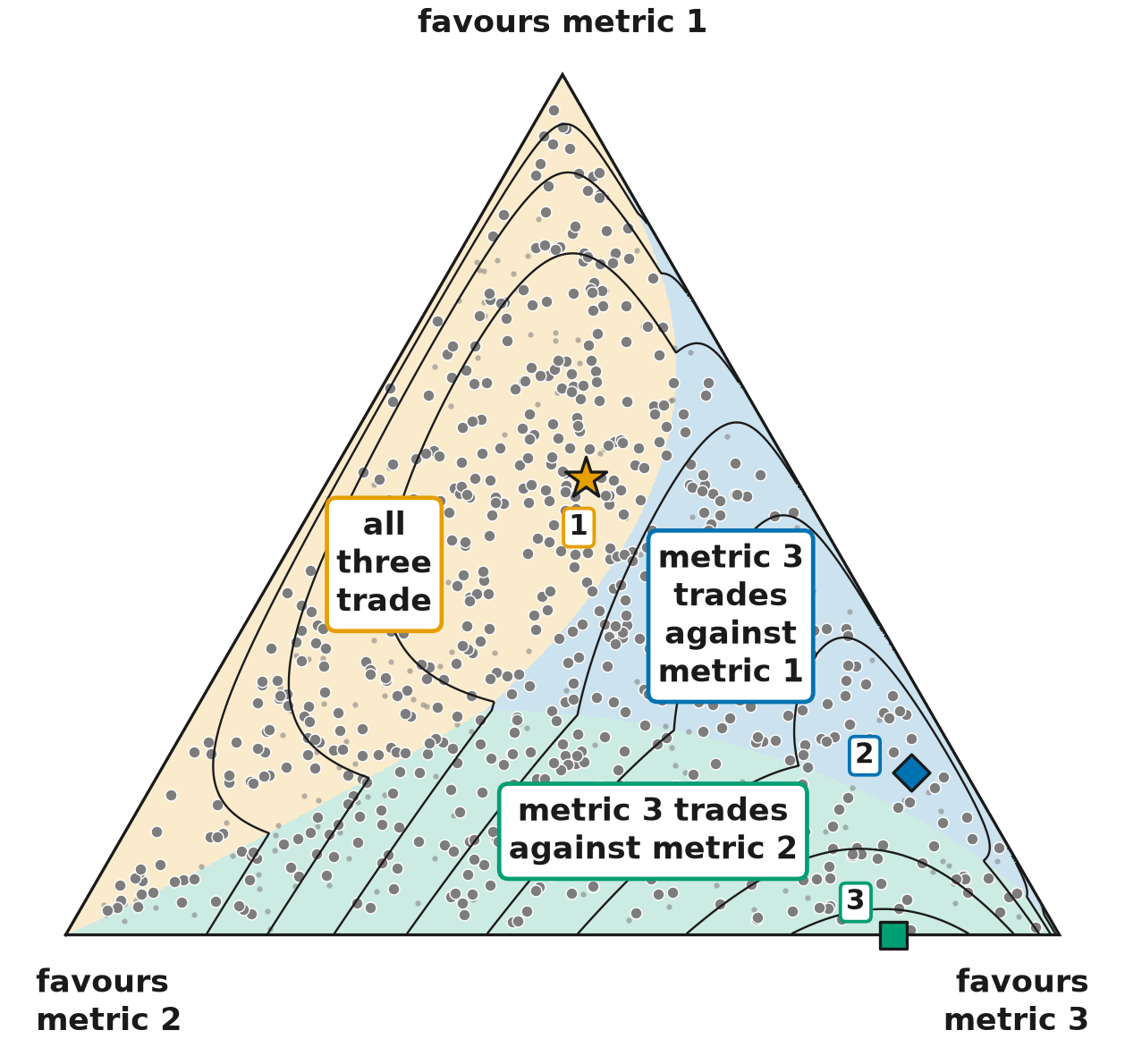
Principal component analysis (PCA) explains variance; this explains trade-offs. Its unit is the n-lemma, a combination
of the metrics that names which of them contend on one part of the trade space. With three metrics, the surface between any two
changes with the third, and terms enter and leave it: in each pane below the fitted reference surface is one curve whose
pieces, one for each term, carry the term’s colour, and on the chart a marker sits at each term’s characteristic point,
where that term is strongest. The
method belongs in unsupervised learning, beside PCA. It is related to PCA, not a replacement for it, and the two chain: the tension report
already runs PCA on the near-frontier chart coordinates. It ships as a scikit-learn-compatible
estimator (fit, transform, inverse_transform,
score_samples). The conformance checks pass.
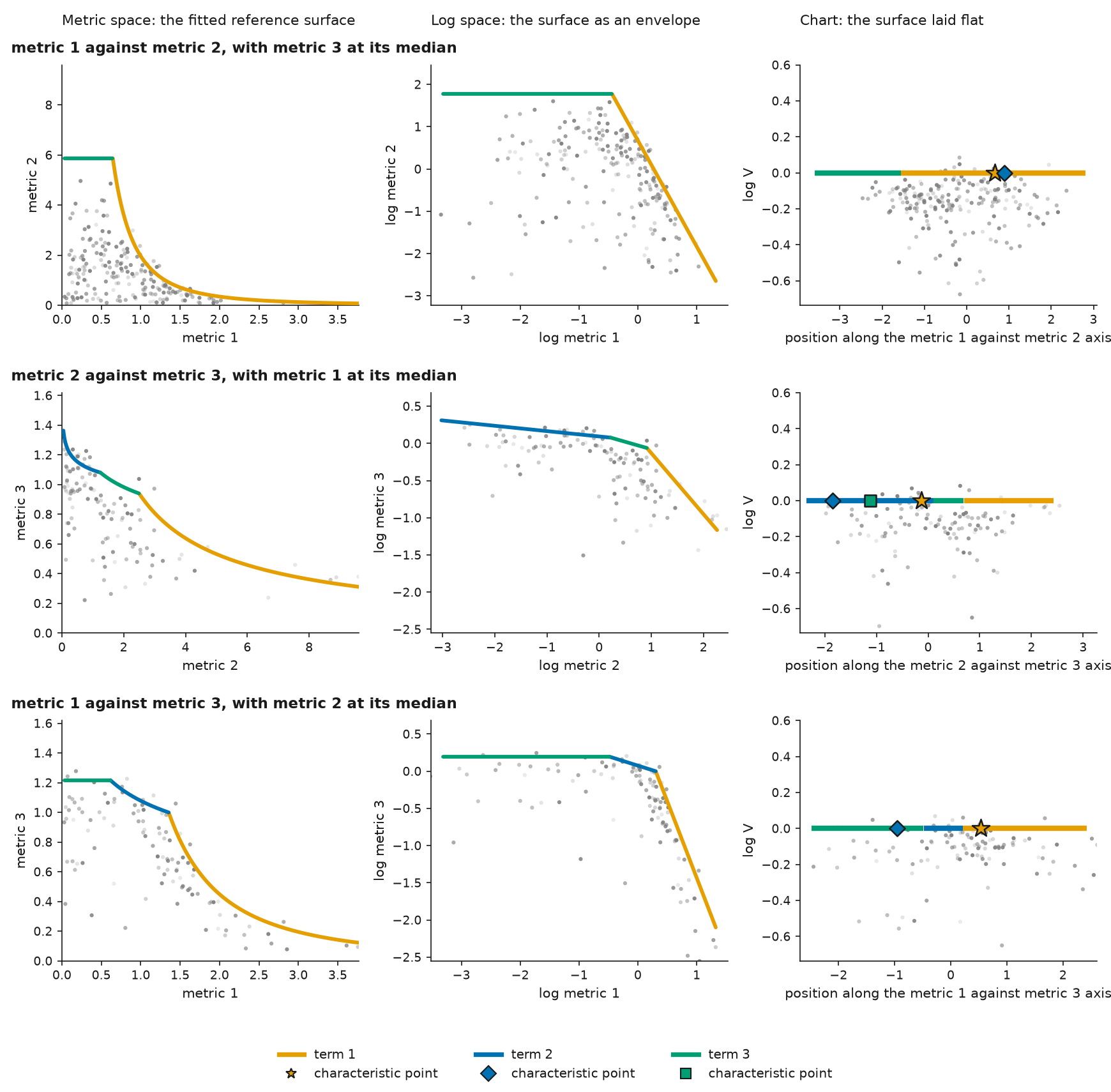
The dataset behind both figures is constructed, with three planted terms, and both are rebuilt step by step in the documentation’s example. The paper makes the argument and gives the proofs; the documentation gets the method running on a dataset of your own.